Choked
The world tends to think of oil as the bloodstream of the global economy.
India’s agrochemical industry, a major global hub for crop protection product manufacturing, is at the heart of a significant policy discussion that could shape the future of agricultural innovation, domestic production, exports, and farmer welfare.




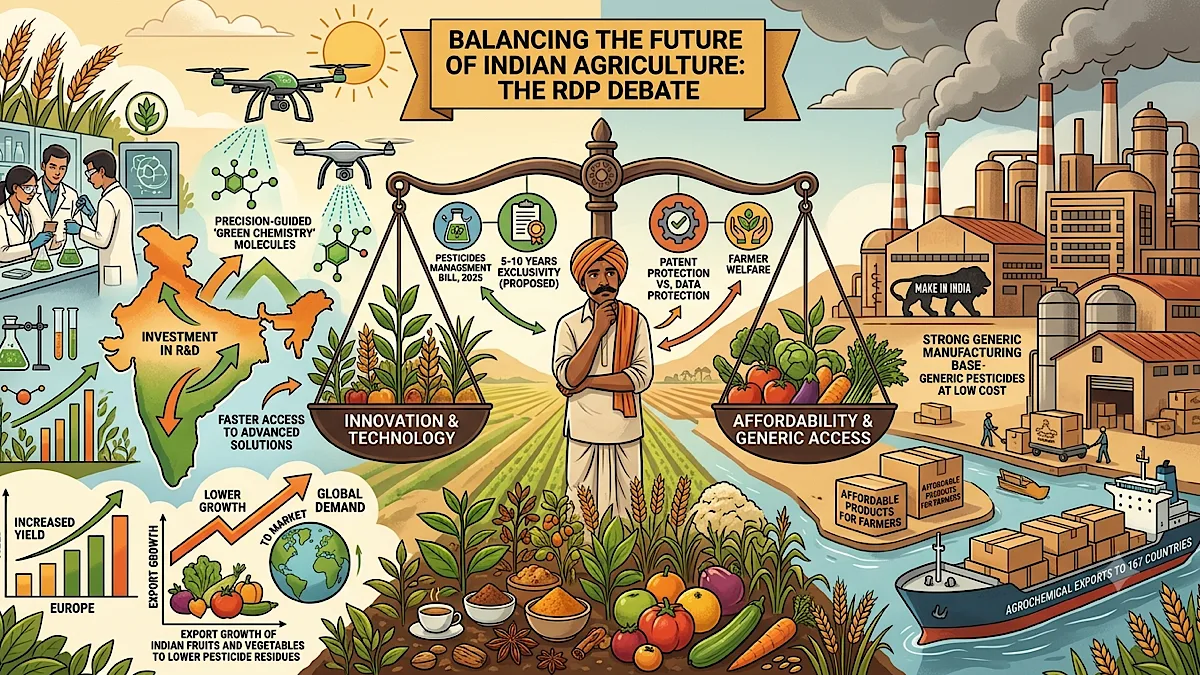
Photo:SNS
India’s agrochemical industry, a major global hub for crop protection product manufacturing, is at the heart of a significant policy discussion that could shape the future of agricultural innovation, domestic production, exports, and farmer welfare. The focus of this debate is the proposed introduction of Regulatory Data Protection (RDP), also known as data exclusivity, into India’s pesticide regulatory framework.
The discussion has gained momentum in the context of the proposed Pesticides Management Bill, 2025, with stakeholders expressing divergent views on whether India should adopt a regulatory data protection regime for agrochemicals, on the lines of several developed and developing countries where such protection is granted for a period of 5-10 years, including China, which provides it for six years. Proponents, including research-based companies and industry associations, contend that RDP is critical for fostering innovation, attracting investment, and facilitating access to advanced crop protection technologies.
Advertisement
In contrast, a few domestic agrochemical manufacturers argue that data exclusivity could restrict competition, weaken India’s strong generic manufacturing base, and potentially increase costs for farmers. At its core, the debate centers on a key policy challenge: Can India manage the right balance between promoting innovation and preserving the affordability and accessibility of crop protection solutions for millions of farmers? The registration of an agrochemical product requires companies to generate extensive scientific data related to toxicology, environmental impact, efficacy, residue behaviour, and safety. These studies often take several years to complete and require significant financial investments.
Advertisement
Regulatory Data Protection (RDP) grants temporary protection over the data submitted by innovators to regulatory authorities. During this period, competing companies cannot rely on the original data package to obtain approvals for equivalent products. Unlike patents, which protect inventions, data protection safeguards the scientific studies submitted for registration purposes, generated as per guidelines of the country where the product is to be registered, with huge investment. Proponents argue that this protection is necessary because developing a new agrochemical molecule involves enormous research costs and regulatory expenditure.
Without data protection, competitors may benefit from these investments without contributing to the research process. However, critics argue that such provisions effectively create an additional layer of market exclusivity beyond patent protection and may delay generic competition. Research-driven companies have consistently advocated for introducing a limited and time-bound data protection framework in India. According to industry estimates, bringing a new crop protection molecule to the market can take more than a decade and involve investments running into hundreds of millions of dollars. Innovators argue that protecting the resulting regulatory data is essential for recovering these investments.
Supporters claim that India is increasingly becoming a secondary market for innovative agrochemical technologies because global companies are reluctant to introduce new products in jurisdictions that do not provide data safeguards. Innovators have proposed a five-year period of regulatory data protection from the date of first registration for a new molecule or a new use. Advocates argue that such a framework would:
* Encourage greater research investments.
* Accelerate the introduction of innovative crop protection technologies.
* Support sustainable agriculture.
* Improve pest resistance management.
* Enhance food security. As climate change continues to alter pest behaviour and disease patterns, access to advanced crop protection technologies is becoming increasingly important. Newer chemistries are often more targeted, environmentally safer, and effective at lower application rates than older products and are of green chemistry. Supporters believe that a modern regulatory framework is necessary if India wants to remain competitive in agricultural innovation.
One of the strongest arguments in favour of data protection is the international precedent. Several major agricultural economies provide regulatory data protection for agrochemical products, as listed in the chart published alongside: (see chart above) India currently has no dedicated statutory framework providing agrochemical data exclusivity. Innovators argue that this regulatory gap discourages technology transfer and delays the launch of innovative products in India.
They contend that harmonizing Indian regulations with international regulations could encourage greater investment and strengthen the country’s innovation ecosystem. As India seeks to modernize agriculture and improve productivity, proponents believe access to advanced crop protection technologies should become a policy priority. Another important dimension of the debate relates to agricultural exports. India is among the world’s largest exporters of tea, spices, fruits, vegetables, rice, and several other agricultural commodities. However, export markets are becoming increasingly demanding regarding pesticide residues, environmental sustainability, and food safety standards.
Supporters of newer crop protection technologies argue that advanced molecules often used in very small quantities leave lower residues and require fewer applications. These characteristics can help farmers comply with increasingly stringent international regulations for increasing exports of Agri commodities as our share today is just ~ 2.4-2.5 per cent. As residue limits continue to tighten in major export destinations such as the European Union, modern crop protection solutions may become essential for maintaining India’s competitiveness in global agricultural trade.
Industry representatives suggest that delayed access to innovative technologies could potentially place Indian farmers at a disadvantage compared to producers in countries where such products are available earlier. Despite these arguments, India’s domestic agrochemical industry has mounted strong opposition to data protection proposals. Recent reports published by AgriBusiness Global highlight concerns raised by industry associations including CCFI and PMFAI, which believe that introducing data exclusivity could undermine India’s highly successful generic manufacturing model.
India has emerged as one of the world’s leading agrochemical producers and exporters by focusing on cost-efficient manufacturing and affordable generic products. Indian companies currently export crop protection products to more than 167 countries, making the country a critical supplier in global agricultural value chains. Challengers argue that introducing additional exclusivity beyond the existing 20-year patent regime could create monopolistic conditions and restrict competition. According to industry representatives, the proposal could delay the entry of generic products even after patents expire, reducing market competition and potentially increasing prices.
They warn that such a policy could conflict with the government’s broader objectives of promoting Make in India, strengthening domestic manufacturing, and enhancing self-reliance. Ultimately, the most important stakeholder in this debate is the Indian farmer. Proponents of RDP argue that farmers stand to benefit significantly from a policy environment that encourages innovation and facilitates the introduction of advanced crop protection technologies.
Access to newer, safer, and more effective products can help farmers address evolving challenges such as pest resistance, climate variability, productivity constraints, and sustainability requirements. Supporters further contend that RDP provides a necessary incentive for companies to invest in costly research, development, and regulatory studies required to bring innovative solutions to the market. By protecting these investments for a limited period, RDP can foster greater innovation, attract global investment, and accelerate the availability of modern agricultural technologies in India. While concerns regarding affordability remain important, advocates of data protection emphasize that innovation and affordability need not be mutually exclusive.
A well-designed regulatory framework can provide appropriate protection for proprietary regulatory data while ensuring that competition emerges after a reasonable period, thereby balancing incentives for innovation with long-term market access. The real policy challenge, therefore, is not choosing between innovation and affordability, but creating a regulatory system that effectively delivers both. An appropriately calibrated RDP framework can help strengthen India’s position as a global leader in agricultural innovation while continuing to support the productivity, competitiveness, and prosperity of Indian farmers. The debate surrounding RDP marks a critical juncture in India’s agricultural and regulatory evolution.
As the country seeks to strengthen its innovation ecosystem and modernize its pesticide regulatory framework, policymakers must establish a balanced approach that supports technological advancement while safeguarding farmer interests and promoting long-term sectoral growth. Supporters of RDP argue that protecting proprietary regulatory data is essential to encourage investment in research and development, facilitate technology transfer, and attract the introduction of cutting-edge crop protection solutions. Given the significant time, cost, and scientific effort required to generate regulatory data, they contend that a reasonable period of protection is necessary to reward innovation and sustain future investments.
While concerns regarding competition and market access deserve careful consideration, many countries have demonstrated that well-designed data protection frameworks can coexist with robust generic industries. A balanced RDP regime can provide innovators with confidence to invest while ensuring that competition emerges after an appropriate period, ultimately benefiting the broader agricultural ecosystem. The implications of this policy debate extend far beyond the agrochemical industry. The outcome will influence agricultural productivity, food security, export competitiveness, research investments, industrial development, and India’s ability to access the latest crop protection technologies.
As India shapes the future of its crop protection sector, the objective should be to create a regulatory environment that rewards innovation, encourages investment, and accelerates the availability of advanced agricultural solutions, while maintaining affordability and accessibility over the long term. A thoughtfully designed Regulatory Data Protection framework can help India achieve these goals, strengthening both farmer prosperity and the nation’s position as a global leader in agriculture and agrochemical production.
(The writer is Chairman Emeritus, Dhanuka Agritech Limited)
Advertisement

![‘Beginning of accountability’: Sonam Wangchuk reveals 3 written assurances from Centre before ending fast [VIDEO]](https://www.thestatesman.com/wp-content/uploads/2026/07/Sonam-Wangchuk-1-1-300x200.webp)


![‘Beginning of accountability’: Sonam Wangchuk reveals 3 written assurances from Centre before ending fast [VIDEO]](https://www.thestatesman.com/wp-content/uploads/2026/07/Sonam-Wangchuk-1-1.webp)